




🪖I Woke Up in 1865 with a Debt, a Widow, and a Rifle Full - The Rifle Is a Red Herring
Underdog Rise DramaBox
 2026-10-27
 17
Click here to watch the full version
He wakes up in 1865 with a rifle in his hands and a debt he can't shoot. That is the joke at the centre of i woke up in 1865 with a debt a widow and a rifle full drama searches, and in my opinion it's the most unexpectedly practical drama DramaBox has released this year — a time-travel story where the hero's superpower is arithmetic and carpentry.
Here's the setup. Martin is a modern special-forces soldier who wakes up in 1865 as a discharged Union engineer. His brother is dead of gambling debts, and the inheritance is a $2,500 note, a cabin on the verge of falling down, and a terrified widow named Susan who has nobody left. So Martin does what a modern soldier with an engineering background would actually do: he fortifies the house, fights off the creditors, and starts building a settlement out of nothing.
No dragon. No system. No magic. Just a man, a ledger and some very good surveying.
Open DramaBox to watch for free
Part 1: The Rifle Is a Red Herring
The title promises violence, and that's the first thing I want to praise the show for refusing.
Look at what happens in the premiere. He wakes up with a rifle — the cover image, the thing you clicked on — and within an episode the rifle is essentially furniture. What he actually uses is the other half of his identity: Union engineer. He digs. He measures. He builds a firing step in the wrong place, improves a drainage line, reinforces a wall that was going to kill somebody.
That's a deliberate downgrade of his firepower and an upgrade of his usefulness, and I think it's the smartest decision in the whole production. A man with a rifle can win one fight. A man who knows how to lay a foundation can keep twenty people alive through a winter, and the show understands the difference.
Most time-travel dramas hand the hero a gun and let him become a legend. This one hands him a level and a plumb line, and somehow it's more tense.
Part 2: $2,500 Is a Better Villain Than Any Man
Then there's the debt, and I want to be specific about why it works so well as an antagonist.
$2,500 is not a vibe. It's a number. That means the audience can track the plot without a narrator: how much came in this episode, how much went out, how close is he to the line. Most dramas with a money problem wave vaguely at "the family's debts" and never tell you the figure, and the suspense evaporates because nothing is measurable.
Open DramaBox to watch for free
And the creditors are a better villain because they don't hate him. They have ledgers. They have terms. They have a legal right to take the cabin and they'll do it on a schedule, politely, while the neighbours watch. There's no monologue, no revenge motive, nothing to negotiate with emotionally — you can't shame a note of hand.
That's much scarier than a man with a knife, honestly. A man with a knife can be fought. A number just sits there accruing.
Part 3: What He Actually Brought Back Was Process
Here's where I think the show is genuinely smarter than its genre usually allows.
The modern-knowledge fantasy normally goes one of two ways: the hero invents something anachronistic and gets rich, or he recites historical events and everyone gasps. This one does neither. Martin's edge is process — how to site a structure, how to keep water clean, how to organise labour so that eight people do the work of fifteen, how to plan a defence in layers instead of one heroic stand.
None of that is a gadget. It's training. And it's a much more honest fantasy, because it's the thing that actually transfers between centuries: method. You can't bring a rifle back, but you can bring a habit of thinking about sight lines and sanitation, and in 1865 those two things are worth more than gold.
I'll admit I did not expect a short drama to make me care about drainage. It got me anyway.
Open DramaBox to watch for free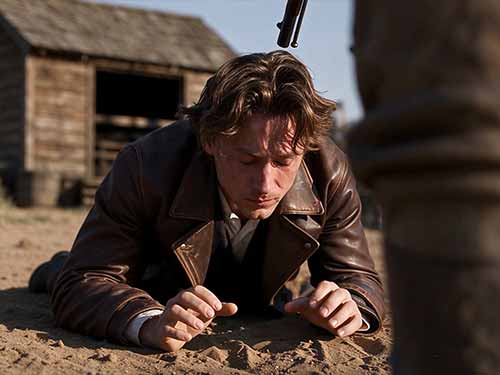
Part 4: Susan Can't Fight the Ledger Either
As for Susan, the terrified widow, I want to talk about her position rather than her personality.
In 1865, a widow with a debt has almost no standing. She can't vote, can't easily hold property in her own name in a lot of places, can't sign her way out of a note, and can't fight a creditor in a room full of men who all know each other. Her terror isn't a character flaw — it's a legal situation. She's the one person in the story whose enemy is a document she was never allowed to argue with.
Which is why her arc has to be built on something other than a speech. Her trust in Martin grows in direct proportion to the balance going down: a fixed roof, a paid instalment, a creditor who leaves without taking the mule. Nothing he says proves anything. Only the ledger does.
And that's a quietly excellent romance structure, because it means every tender moment is also collateral. I like that a lot more than a declaration in a field.
Part 5: The Cabin Is the Scoreboard
The last structural thing I want to point out is the set itself, because the cabin is doing the work a chart would do.
It starts as a collapsing ruin — the visual definition of "there is nothing here." Then it becomes a fortified home: braced, drained, defensible. Then the camera pulls back and it's a settlement, and the story has quietly changed genre from survival to politics without announcing it.
Open DramaBox to watch for free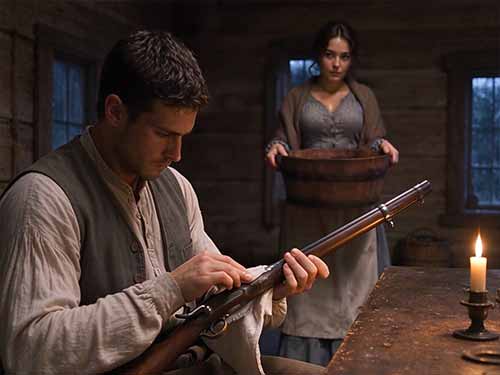
That's a very clean progress bar, and it's honest about what a house meant in 1865. It wasn't a lifestyle asset; it was the difference between a winter you survive and one you don't. So every beam he sets is a stake the audience can actually feel, which is more than most of these shows manage with a magic system.
Judging by how much i woke up in 1865 with a debt a widow and a rifle full drama gets passed around after the mid-point, I'm not the only one who got invested in a fence.
Part 6: Who This Is For (and Where to Watch It)
Fit check. If you like competence porn — watching someone good at their job solve physical problems in order — this is basically engineered for you. If you enjoy period detail and the fantasy of being useful in the past rather than famous in it, same. And if you've ever wanted a time-travel drama where nobody invents a machine gun in episode six, come in, the water's fine, and it's been properly drained.
Who should skip it? Anyone who needs romance to lead. This is a building story with a slow, careful relationship inside it, and the relationship is measured in instalments. Also anyone hoping for battlefield spectacle — the fights here are short, defensive and practical, and the real drama happens in a room with a contract on the table.
If you want i woke up in 1865 with a debt a widow and a rifle full drama in the correct order, that's genuinely important here, because the whole pleasure is watching the numbers move — DramaBox carries the full movie run in sequence, so you can watch online from the day he wakes up and watch free, rather than starting at the settlement with no idea what it cost to build.
Open DramaBox to watch for free
Final Verdict: The most satisfying budget in the genre
A soldier, a widow, a collapsing cabin and a number that won't stop growing. It's tense without being loud, clever without showing off, and it does the one thing time-travel dramas almost never bother with: it makes the past expensive.
Watch it in order and watch free on DramaBox — and keep an eye on what things cost, because in this show the price tag is the plot.
Click here to watch I Woke Up in 1865 with a Debt, a Widow, and a Rifle online
FAQ
Where can I watch I Woke Up in 1865 with a Debt, a Widow, and a Rifle in full?
All available episodes are on DramaBox. Anyone searching i woke up in 1865 with a debt a widow and a rifle full drama tends to find the shooting scenes and none of the building, which is the wrong half of the show. The full movie feed runs in sequence, you can watch online from the first morning in 1865, and it costs nothing to watch free.
Does he ever pay off the $2,500?
I'm not going to hand you the ledger. What I'll say is that the debt stops being the main problem before the story ends, and how it stops being the problem is the most satisfying part of the back half. The show is much more interested in what a man does after the number is gone than in the number itself.
What should I watch after this one?
If what hooked you in i woke up in 1865 with a debt a widow and a rifle full drama was a man rebuilding from absolutely nothing, The Vanished Champ Strikes Back runs 56 episodes of exactly that comeback. For the climb-from-poverty engine, For Richer, For Poorer gives you 65 episodes of it. And if the out-of-time premise is the real draw, The Time Traveler's Guide Home is 70 episodes of someone building a life in a century that isn't theirs.