




The Bride They Feared, The Queen They Crowned Chinese Drama: From Abandoned Bride to Crowned Queen
Concealed Identity DramaBox
 2026-01-13
 412
412🏰👑From Abandoned Bride to Crowned Queen: Why The Bride They Feared, The Queen They Crowned Chinese Drama Is a Must Watch
When a Woman Chooses the Throne Over Mercy
Some stories begin with love. Others begin with betrayal. The Bride They Feared, The Queen They Crowned opens with a woman standing at the edge of humiliation, offered a life stripped of dignity, and making a choice so radical that it terrifies everyone around her.
Bella Elmer is not born weak, yet she is raised in a household where affection is conditional and power decides worth. When her half sister steals not only her wedding gift but her entire marriage arrangement, Bella is expected to accept a future as a concubine, a decorative afterthought in a life she was promised first. What makes this opening resonate so strongly with audiences is how painfully familiar it feels. Many viewers recognize this quiet coercion, the social pressure to endure injustice gracefully.
Instead of pleading, Bella volunteers for what appears to be a death sentence. She offers herself to marry the rumored eighty year old King of Bexar, a figure associated with decay and political fear. This single decision shifts the entire narrative. It is not desperation that drives her, but strategy. By choosing the most dangerous path, she reclaims control over her fate.
This moment sets the tone for The Bride They Feared, The Queen They Crowned Chinese Drama. The series is not about waiting for rescue. It is about agency forged under threat. Bella’s courage is not loud, yet it is relentless, and that quiet determination becomes the emotional core that sustains the drama across its many twists.
Open DramaBox to watch for free
A Wedding Night That Rewrites Destiny
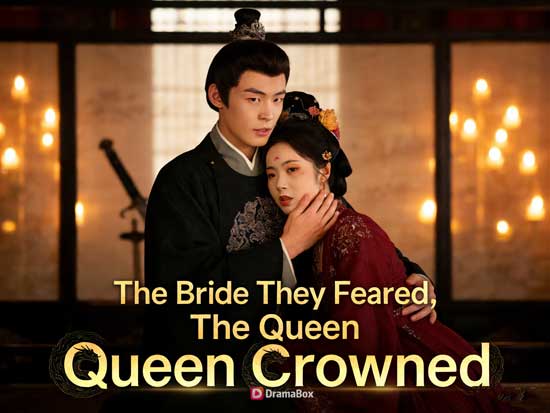
The drama’s most iconic turning point arrives on Bella’s wedding night. Expecting vulnerability, she prepares instead for survival, knife in hand, ready to defend herself against a future she refuses to accept passively. What follows is not just a shocking reveal, but a narrative reorientation.
The man she is meant to marry is not an aging ruler awaiting death. He is Marcus Keagan, the feared god of war, concealed behind rumor and political misdirection. This revelation does more than ignite romance. It reframes power itself. Both leads enter the marriage under false assumptions, each guarding their own truth.
The relationship that unfolds between Bella and Marcus is built not on illusion, but on recognition. They see each other clearly through layers of deception, and that mutual clarity becomes their strongest weapon. Their bond grows through shared battles, political chess games, and moral alignment rather than shallow attraction.
Set against a historical backdrop of shifting alliances and court manipulation, the story blends royalty intrigue with the brutality of war, while grounding its emotional stakes in trust earned rather than assumed. The drama explores destined love without reducing its heroine to fate alone, allowing Bella’s intelligence to shape destiny instead of merely receiving it.
As their marriage evolves into a strategic partnership and eventually genuine affection, the series leans confidently into love after marriage, a trope beloved by audiences who appreciate emotional depth over instant infatuation.
Cast Introduction
Yao Hui as Bella Elmer
Born in 2002, Yao Hui brings remarkable composure and emotional depth to Bella. Her previous short drama works include Stealing Her, Twin Jade Scheme, Cold Moon Over the Heartless, Firefly, Strategy of a Concubine, After Divorce She Rose Beyond Reach, and Waiting for Flowers, Waiting for You. Her performance here marks a clear evolution toward commanding lead roles.
Huang Jingzhou as Marcus Keagan
Born July 3, 1998 in Wenzhou, Zhejiang, Huang Jingzhou is known for Cheng Xi Qu and Ancient Love Song. His portrayal of Marcus balances restraint and intensity, avoiding caricature while maintaining mythic presence.
Xie Mingrui as Bella’s Father
Born in 1990, height 180 cm, weight 70 kg, from Nanyang, Henan. His previous works include Phoenix Sings to the Ninth Heaven, Heart’s Desire, and Eighteen Years Raising a Son for One Coronation. His performance adds emotional complexity to the family conflict.
Deng Yuqi as Bella’s Mother
With twelve years of acting experience, Deng Yuqi has appeared in numerous films and dramas, including short dramas such as Phoenix Returns to the Nest, Sword Twenty Four, and Who Sends Paintings from the Clouds. Her restrained performance deepens the emotional texture of the maternal role.
The Marriage Everyone Mocked Becomes the Most Dangerous Alliance in the Realm
What makes The Bride They Feared, The Queen They Crowned quietly addictive to Western audiences is how it weaponizes marriage, not as a romantic endpoint, but as a political arena. From an American viewer’s perspective, the most compelling twist is not that Bella survives humiliation, but that she reframes marriage itself as a calculated move in a larger power game. This is not a woman waiting to be loved correctly. This is a woman choosing the battlefield on which she will win.
Bella’s decision to marry the so called dying king reads, at first, like a tragic sacrifice. But as the story unfolds, it becomes clear that she understands something the men around her do not. Power is not always loud. Sometimes it hides behind rumors, age, and carefully constructed fear. That realization resonates deeply with modern audiences who are tired of heroines defined by endurance alone. Bella does not endure. She positions herself.
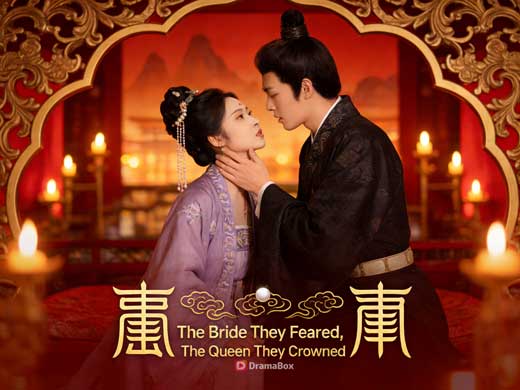
The wedding night scene in particular feels tailor made for English speaking viewers who appreciate tension driven storytelling rather than melodrama. The knife in Bella’s hand is not just self defense. It is a visual declaration of autonomy. When Marcus Keagan reveals himself, the scene flips from expected victimhood into mutual assessment. Two strategists meet under false premises, both measuring risk, both calculating trust. It feels less like a fairy tale reveal and more like the beginning of a power negotiation.
American audiences often gravitate toward stories where romance is earned through respect and shared intelligence, and this drama understands that instinctively. Bella does not soften when she discovers Marcus’s identity. She recalibrates. Marcus does not dominate the dynamic. He adapts. Their chemistry is built on competence recognition, a concept deeply satisfying to viewers who value partnership over possession.
What truly sets this marriage apart is that neither character enters it seeking emotional validation. Bella seeks safety and leverage. Marcus seeks stability and truth. Love emerges not from fantasy, but from aligned objectives. That slow burn is what makes their bond feel credible across cultural boundaries. It mirrors contemporary conversations about marriage as collaboration rather than rescue.
For English language audiences unfamiliar with Chinese historical dramas, this relationship becomes an entry point. The politics feel complex but emotionally legible. The stakes are clear. Power is dangerous. Trust is rare. And intimacy becomes meaningful precisely because it is chosen under threat.
Open DramaBox to watch for free
A Female Comeback Story That Feels Strikingly Modern
What surprises many Western viewers is how modern Bella’s emotional logic feels, despite the ancient setting. Her journey aligns closely with contemporary narratives about reclaiming agency after betrayal. When her half sister steals her future and her fiancé attempts to demote her into silence, Bella’s response mirrors a sentiment many American women recognize deeply. If the system is rigged, step outside it entirely.
Rather than fighting for scraps of dignity within a corrupt family structure, Bella exits the game and rewrites the rules. This is why her arc resonates as a true comeback story, not a revenge fantasy. She does not seek to humiliate her enemies publicly. She seeks irrelevance for them. Her success lies in how thoroughly she outgrows the people who tried to define her.
The family intrigue in this drama feels particularly sharp to Western audiences accustomed to psychological thrillers. The cruelty is subtle. Smiles conceal manipulation. Affection is transactional. Bella’s parents embody a familiar emotional neglect that many viewers find unsettlingly real. Her father’s cold calculations and her mother’s constrained compliance reflect systems that prioritize status over protection.
Bella’s transformation is not instantaneous. She makes mistakes. She hesitates. She learns when to speak and when silence carries more weight. This gradual evolution feels refreshing in a genre often criticized for overnight empowerment. Her intelligence is not performative. It is adaptive.
What also appeals strongly to American viewers is how Bella’s independence does not isolate her. She builds alliances without surrendering authority. Her partnership with Marcus evolves into something resembling modern power couples portrayed in Western prestige dramas. They disagree. They negotiate. They challenge each other’s blind spots. There is no savior dynamic here, only mutual reinforcement.
The show’s visual language reinforces this modern sensibility. Camera work lingers on reactions rather than declarations. Power shifts occur through withheld information rather than dramatic speeches. This restraint aligns closely with Western storytelling preferences, making the drama feel accessible even to viewers unfamiliar with palace hierarchies.
Bella’s rise ultimately satisfies because it feels earned psychologically. Her crown is not symbolic. It represents competence recognized too late by those who dismissed her. That narrative of delayed acknowledgment hits especially hard for audiences who have experienced systemic undervaluation.
Why This Drama Resonates: Power, Perspective, and Visual Storytelling
What elevates The Bride They Feared, The Queen They Crowned Chinese Drama beyond familiar palace intrigue is its commitment to perspective. The story is told through Bella’s evolving consciousness, not merely her circumstances. We witness how betrayal sharpens her judgment, how restraint becomes a form of resistance, and how leadership is learned rather than inherited.
Bella’s transformation is not cosmetic. She does not suddenly become powerful through marriage alone. Her rise is a calculated counterattack, built on patience, observation, and moral clarity. The drama excels in depicting family intrigue not as melodrama, but as a system of survival where silence can be as lethal as open hostility.
Marcus Keagan’s role complements rather than eclipses her arc. His hidden identity allows the narrative to explore masculinity without dominance. He is formidable in battle, yet respects intelligence over obedience, creating a relationship dynamic that resonates strongly with modern audiences.
Visually, the drama balances intimacy and spectacle. The camera lingers on small gestures, tightened grips, exchanged glances, moments where trust is negotiated without words. Costume design evolves alongside character growth, reinforcing Bella’s shift from constrained daughter to sovereign presence without overt symbolism.
This is a comeback story rooted in realism. Bella does not erase her trauma. She carries it, learns from it, and refuses to let it define her limits. As an independent woman, she commands authority not by denying vulnerability, but by mastering it.
For international viewers discovering the series on DramaBox, its availability as a Full Episode experience with English Version options and English Subtitles has helped it reach audiences far beyond its original release. Its Exclusive copyright status and First release on the entire network contributed to sustained online discussion and clip circulation across YTb, further amplifying its visibility.
Personal Verdict: A Palace Drama That Knows Its Power
From a critical perspective, The Bride They Feared, The Queen They Crowned Chinese Drama succeeds because it respects its audience. It does not underestimate emotional intelligence, nor does it rely solely on shock to maintain engagement.
The pacing remains tight, especially impressive given the genre’s tendency toward narrative sprawl. Some secondary antagonists could benefit from deeper exploration, yet their narrative function remains clear and effective. The emotional throughline never wavers.
This is not a passive fairy tale. It is a meditation on choice under constraint. Bella’s journey invites viewers to reconsider what strength looks like when options are limited, and dignity must be defended rather than granted.
For viewers seeking a Free Movie style viewing experience that still offers narrative sophistication, this drama delivers both entertainment and reflection. It proves that short form historical dramas can achieve thematic weight without sacrificing momentum.
Final Reflection: The Crown Was Never Given, It Was Claimed
At its heart, this story asks a question many women recognize. What happens when survival demands courage greater than obedience?
The answer unfolds through resolve, partnership, and the refusal to accept a life defined by others’ ambitions. The Bride They Feared, The Queen They Crowned Chinese Drama does not merely depict ascension. It interrogates the cost of power and the grace required to wield it well.
If you are drawn to stories where intelligence triumphs over cruelty and love grows alongside authority, this series deserves your attention.