




DramaBox as a Creative Ecosystem: Opportunities for Writers, Actors, and Studios
Small Potato DramaBox
 2026-01-29
 628
628DramaBox as a Creative Ecosystem: Opportunities for Writers, Actors, and Studios
By Jacky Zhang
Published: January 29, 2026
Category: Short Drama Industry Analysis · Job Seeking · Employment Opportunities · Creative Economy · DramaBox
Introduction: A New Creative Frontier
In the rapidly expanding world of short-form dramas, platforms like DramaBox are not merely entertainment outlets — they are creative ecosystems that reshape how stories are developed, produced, and monetized. Far from being passive distribution channels, these platforms actively influence narrative formats, opportunities for creative professionals, and the economic structures of serialized storytelling.
The global short drama market has experienced explosive growth, with app downloads exceeding hundreds of millions and in-app revenue climbing into the hundreds of millions annually. In Q1 2025 alone, short-form drama apps generated nearly $700 million in in-app purchases across 370 million downloads, with DramaBox among the leading contributors in both engagement and revenue generation.
Such scale has transformed what was once niche into a viable creative economy — but with both new opportunities and unique tensions between industrialized production processes and creative freedom.
Open DramaBox to watch for free
The Macro Picture: Market Growth and Creative Demand
The short drama industry has shifted from experimental format to mainstream entertainment. Analysts forecast the short drama sector — including vertical mini-dramas optimized for mobile viewing — into a multi‑billion‑dollar segment, with global market value growing from about $6.5 billion in 2024 to over $7 billion in 2025, and projected to nearly $12 billion by 2030.
In this broader landscape:
DramaBox is available in over 200 countries and regions and hosts thousands of short drama series.
The platform achieved tens of millions of monthly active users — a competitive level rivaling major streaming services in sheer engagement.
It received significant awards such as the Sensor Tower Award for Best Short Drama App and Google Play’s Best Entertainment App of 2024.
This macro demand creates a vibrant creative marketplace for writers, actors, and production studios — but also shapes expectations about speed, scalability, and return on investment.
Where the Creative Ecosystem Takes Shape
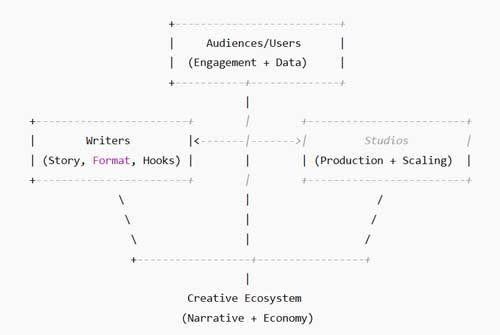
DramaBox’s ecosystem impacts creative professionals in several interconnected ways — from script generation pipelines to casting opportunities and revenue participation. Below is a conceptual framework of the ecosystem:
Open DramaBox to watch for free
Each group feeds into and is shaped by the others — and DramaBox functions as both marketplace and curator of these interactions.
Opportunities for Writers: From Speed to Story Innovation
Short drama formats demand a new set of writing skills:
Concise structure: Writers must establish character, conflict, and emotional stakes within minutes of screen time.
Episode hooks: Each episode requires micro‑cliffhangers that sustain audience retention.
Flexible genre modeling: Scripts often intersect romance with thriller, sci‑fi, or mystery elements.
Platforms like DramaBox have begun formalizing writer pipelines. In partnership with networks such as Stage 32, DramaBox launched what it calls the world’s first vertical drama incubator, providing structured training and script review for emerging creatives.
This is a tangible shift from the historically closed, top-down script procurement model dominant in traditional TV. By lowering barriers and integrating writers more directly into the platform’s production ecosystem, DramaBox nurtures new talent pipelines and expands the range of storytelling voices.
Moreover, industry demand is massive: DramaBox and its peers reportedly generated around $450M–$490M in cumulative revenue by early 2025, with continued aggressive growth in audience engagement. Such economic scale creates monetary incentives for original creators that simply did not exist in vertical video formats a few years ago.
Actors and Performers: Visibility and Career Pathways
For actors and performers, short dramas open alternative professional avenues. Traditional film and television roles are highly competitive and often require established reputations or agency support. In contrast, short dramas:
Provide frequent casting opportunities due to high production volumes.
Allow performers to build digital portfolios with quantifiable viewership metrics.
Enable fan engagement and community cultivation via platform commenting features.
Although some audiences have noted inconsistent crediting practices on certain titles (often due to licensing or export issues), many performers have gained followings across shows, contributing to micro‑celebrity ecosystems where smaller actors achieve recognition that might not have been possible in conventional formats.
Studios and Production: Industrialization Meets Creativity
Unlike traditional long‑form productions, short dramas operate on lean cycle models. Budgets per project are typically lower, but the frequency and volume of content are higher — a pattern that resembles mobile gaming economics more than linear TV production.
This has several implications:
Studios can test narrative concepts rapidly, adapting to audience feedback in near real time.
Production teams are rewarded for efficiency and output, not simply scale.
Content pipelines must balance creative quality with industrial throughput — a tension that informs hiring, scripting, and editing practices.
Platforms like DramaBox serve as both curators and clients for studios, amplifying content that aligns with audience data signals (retention, click‑through, completion rates). This data‑driven model encourages iterative production, where studios refine story elements based on measurable engagement patterns.
Industrialization vs. Creative Freedom
A central tension within the DramaBox ecosystem arises from the push–pull between industrialized production and creative freedom. On one hand, the demands of rapid content output favor standardized or formulaic storytelling — narrative structures that reliably generate watch time and monetization. On the other hand, creators seek space for innovation and artistic expression.
The tension is not insignificant: too much industrial standardization risks creative homogenization, but too much freedom risks audience disengagement in a format designed for predictability and retention. DramaBox’s role, therefore, is partly ecosystem steward — enabling scalable workflows while preserving narrative diversity across genres and cultural contexts.
Emerging trends show that platforms incorporating localized production and genre experimentation (beyond just romance) are likely to thrive, especially as micro‑drama consumption expands into regions like Latin America, Southeast Asia, and the U.S.
The Data Story: Growth and Creative Demand
Below is a snapshot of global short drama ecosystem metrics (Q1 2025):
| Metric | Approximate Value |
|---|---|
| Global short drama app downloads | ~370 million |
| Total in‑app revenue (industry) | ~USD $700 million |
| DramaBox cumulative revenue | ~USD $450 million (approx.) |
| Short drama global market value | ~USD $7–11+ billion (forecast) |
| Countries with DramaBox reach | 200+ |
| Sources: Market & analytics reports |
These figures show not only the commercial traction behind short dramas but also the creative demand — content creators are needed to service this burgeoning audience at scale.
Conclusion: An Ecosystem With Structural Promise
DramaBox’s role in the short drama ecosystem goes far beyond that of a content platform. It is a creative market builder, enabling thousands of writers, actors, and studios to participate in a form of industrialized narrative production while still carving out space for artistic experimentation.
By lowering barriers to entry, providing structured development avenues, and blending data‑driven production with global cultural reach, DramaBox exemplifies how new media ecosystems can balance economic incentives with creative opportunity.
For the next wave of storytellers, short‑form drama platforms represent not just a distribution channel, but a creative economy in its own right — one where narrative innovation, audience engagement, and professional possibility intersect.