




The Lost Son of Zeus: His Return Watch Online : He Came to Olympus to Save Someone — Not to Claim a Throne
Counterattack DramaBox
 2026-09-03
 16
16Click here to watch the full version of The Lost Son of Zeus: His Return
A god's son is stolen as a child and swapped for a mortal. Eighteen years later he walks into Olympus — not to claim his birthright, but to save the person he loves. On DramaBox, this is one of the most satisfying divine-identity dramas I have watched, and the reason the lost son of zeus his return watch online keeps climbing is that motivation.
Here is my take in six parts.
Part 1: He Didn't Come Back for the Throne
Let's start with the detail that separates this from a hundred identical setups.
Hercules does not return to Olympus to claim anything. He goes to join the Divine Guards because he is trying to save someone he loves. At that point in the story, he has no idea he is Zeus's son at all.
Open DramaBox to watch for free
In my opinion, that single choice lifts the entire premise. Compare it to the standard version, where the hidden heir returns knowing exactly who he is and spends thirty episodes proving it. That is a story about entitlement. This one is about a young man walking into the most dangerous place in the world for somebody else.
It also makes everything that happens afterward so much worse. He is not there to make a claim, so he cannot even be accused of ambition. He is there to serve. And the family he is trying to serve crushes him for it.
As for me, I find that almost unbearable in exactly the way good melodrama should be. A character who wants nothing for himself is the hardest one to watch suffer.
Part 2: Icaris — The Name Already Tells You
Now the thing I cannot stop thinking about, which I have not seen anyone else point out.
The impostor is named Icaris.
In Greek myth, Icarus is the boy who flew too close to the sun on wings of wax and feathers, and drowned when they melted. He is the patron saint of people who were given more altitude than they could handle.
Put that next to a mortal boy raised as the son of Zeus and it lands hard. Icaris is not evil because he is powerful — he is dangerous because he was placed somewhere he cannot survive. Every scene where he schemes to keep Hercules down is a scene of a boy trying to stay airborne with wax melting off his arms.
I have no idea whether this was deliberate. But whether or not the writers planned it, the echo is there, and I think it makes Icaris a far more interesting villain than the usual sneering rival. He is not a monster. He is someone who cannot land safely, and he knows it.
And the ending he chooses — conspiring with Hades rather than surrendering the stolen life — is precisely what Icarus would do. Higher, not down.
Open DramaBox to watch for free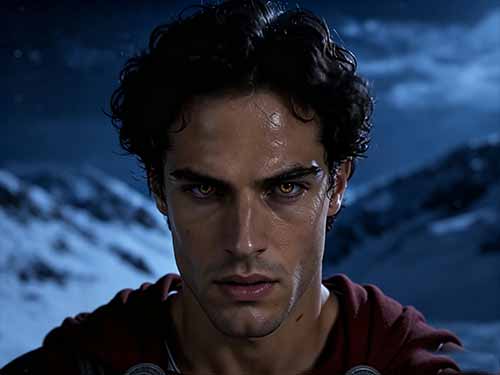
Part 3: The Cruelest Part Is That It Happens at Home
Here is what I think the story gets genuinely right about cruelty.
Hercules is not tormented by strangers on a battlefield. He is suppressed and exiled by his own family, who simply do not know who he is. He comes home, and home does not recognize him.
That is a very specific and very old kind of pain. Anyone who has ever been misunderstood by the people who were supposed to know them best will feel this one in their teeth. The insult is not that strangers were cruel; it is that the cruelty happened in the place that was supposed to be safe.
And it is Icaris doing the instigating, which makes the geometry almost elegant: the thief sits inside the house, pointing the family at the true son and whispering that he does not belong.
Let's be honest: I wanted to reach through the screen more than once. But I also think the show earns that reaction rather than manufacturing it, because the betrayal is structural rather than random.
Part 4: When Ability Is the Only Proof That Works
Now the part that makes the hidden-identity engine actually function.
Hercules outperforms Icaris. Not through politics, not through connections, and not through anyone's favor — just through being better at the thing everyone is being measured on.
Open DramaBox to watch for free
I like this because it is the cleanest possible proof. In a story where nobody believes his identity and every piece of evidence is contested, competence is the one argument that cannot be bribed. He cannot be talked down, because the results keep arriving.
There is also a quiet satisfaction in the fact that the thing meant to hide him — his mortal upbringing, with no divine training — does not diminish him. Whatever he is, he is not less than the boy who had everything handed to him. If anything, the eighteen hard years are the reason he wins.
In my opinion, that is the most quietly subversive thing in the premise: the stolen childhood did not weaken him. It forged him.
Part 5: The Apology Problem — Who Are They Apologizing To?
Now the part I want to be careful with, because I think it deserves more scrutiny than it usually gets.
Once the truth comes out, Zeus's family desperately begs for forgiveness.
And here is the question I could not shake: who exactly are they apologizing to?
Because the person they exiled was, as far as they knew, a mortal upstart with no name. They suppressed him then. They only beg now that he turns out to be a god's son.
Which raises an uncomfortable possibility — that the apology is addressed to his status rather than to his suffering. If the truth had never surfaced, would they have stopped? Based on everything we have seen, the honest answer is probably not.
Open DramaBox to watch for free
I am not saying his family is irredeemable. Grief and confusion are real, and being deceived by someone inside your own house is genuinely disorienting. But I do think the show is braver than it needs to be by letting that question hang there instead of immediately absolving everyone.
Forgiveness is his to give. It just should not be treated as automatic.
Part 6: Who Should Watch It — And Where to Watch It
I would hand this to anyone who enjoys Greek mythology reworkings, switched-at-birth stories, hidden heirs, and the specific catharsis of a hero being vindicated by results rather than words.
It is especially good if you like your revenge earned slowly. The reveal here is not a single scene; it is a slow accumulation of a young man being better than everyone expects while being treated worse than anyone deserves.
A practical note, since a lot of people find this one in pieces: the arc only works in sequence. If you want the full movie — the theft, the eighteen years, the exile, and the reckoning — the clean route is to watch free on DramaBox, where episodes stay in the order the reveals were built to land. That is also where the lost son of zeus his return watch online gives you the whole run with subtitles that have not been mangled by a re-upload.
Final Verdict: The Son Who Came Home a Stranger
For me, The Lost Son of Zeus: His Return works because it understands that the reveal is not the point — the years before it are.
Hercules did not come to Olympus for a crown. He came to save someone, got exiled by his own blood for the trouble, and turned out to be the most capable person in the room the entire time. That combination is hard to look away from.
Icaris is the sharper creation: a boy with wax wings who would rather burn than land. And the family's apology lands with the exact weight it deserves, which is to say, an uneasy one.
Is it a fantasy? Completely. Is it a satisfying one? Enormously.
Skip the fragments and stream the full movie on DramaBox, where you can watch free and follow the lost son of zeus his return watch online from the theft to the reckoning in one clean run.
Click here to watch The Lost Son of Zeus: His Return free on DramaBox
FAQ
Where can I watch the full movie online?
DramaBox has the complete run, and you can watch free there. Order matters here — the exile only stings because of the eighteen years that precede it, and clips almost always open with a Divine Guards trial and skip the theft entirely. Most the lost son of zeus his return watch online searches turn up exactly those fragments.
Does Hercules get his place on Olympus back?
I am not walking through the ending, because how the reckoning resolves is most of the reason to watch. What I will say is that the premise sets up a harder question than "does he win" — it asks whether a family that only recognized him after the fact deserves to be recognized by him. A story that spends this long on his suffering cannot simply hand out a reconciliation in the last five minutes.
What should I watch next if I liked this one?
If the lost son of zeus his return watch online hooked you with the returned-warrior thread, The Spartan War God Returns runs fifty-nine episodes on a very similar comeback, with more battlefield spectacle.
If you liked the hidden-divine-blood element, I Married the Hidden Lion King builds seventy episodes around a concealed bloodline and the people who underestimated it.
And if what you wanted was the awakening followed by everyone who mocked him kneeling, Kneel Before The Dragon Queen delivers that arc in a tighter forty-one.