




🪙Tit for Tat Darma : Nobody Ever Said No to Them
Revenge DramaBox
 2026-09-09
 4
4Click here to watch the full version of Tit for Tat on DramaBox
A woman in labour. A car run off the road. A husband who does nothing. In my opinion, that is why tit for tat drama searches keep climbing — the setup is almost unbearable to sit through. For me, this is one of the most controlled DramaBox releases in a while, because it trusts consequences to arrive on their own.
What follows is my take in five parts, ending with what I think the title is actually billing.
1. "Brats" Is the Most Precise Word in the Synopsis
Let's start with the label, because I don't think it's casual.
The synopsis doesn't call them villains, or criminals, or thugs. It calls them brats.
Open DramaBox to watch for free
That's a specific kind of person. A brat isn't someone who has weighed the options and chosen cruelty. A brat is someone who has never been told no — not because they're feared, but because nobody with the authority to stop them ever bothered.
Which means the ruin coming for the Westons isn't really punishment in the usual sense. Punishment implies someone who knew the rule and broke it. This is the first time the rule is being enforced at all.
And that reframes the satisfaction on offer. We're not watching a bad person get what's coming. We're watching a person encounter consequence for the first time in their life, at full speed, with no parent in the room to wave it off.
Honestly, I find that colder and more satisfying than a standard revenge plot. Revenge implies a debt being collected. This is more like gravity finally being noticed.
2. The Ruin Lands on the Family, Not on Them
Here's the detail I keep turning over: the brats bring ruin upon their own family, the Westons.
Not on themselves. On the family.
That distinction matters more than it looks. These are people who have spent their whole lives operating inside a structure designed to absorb the cost of their behaviour — money, name, lawyers, reputation, someone's phone call. Being a brat is only sustainable if there's a larger entity quietly paying your bills, including the ones you don't know about.
Open DramaBox to watch for free
So the cruellest possible outcome isn't that they personally suffer. It's that the thing they've been drawing on gets destroyed instead.
Which is, structurally, perfect. The machine that made them untouchable is the thing that breaks. Not their feelings, not even their freedom — the apparatus that guaranteed none of this would ever reach them.
I'll admit I had a small, uncharitable moment of pleasure reading that line. A story that punishes the shield rather than the person holding it understands something most revenge dramas don't.
3. "Forced Off the Road" Is the Cruellest Kind of Malice
Notice what they actually do. They don't stop. They don't get out. They don't say anything Hugo could repeat to a judge.
They just drive.
That's a very particular kind of hostility, and I think it's the most realistic part of the whole setup. Forcing someone off the road leaves almost nothing to hold onto. There's no threat quoted, no name exchanged, no witness who can say with confidence that it was deliberate rather than bad driving. Just a car that seemed to come out of nowhere.
Malice that leaves no evidence is harder to answer than malice that announces itself. You can respond to an insult. You can't respond to "he drove aggressively" — there's nothing there to grab.
So this isn't just the inciting incident. It's the reason Hugo's restraint is the only available option. Not restraint as nobility — restraint as the absence of anything to push against.
Open DramaBox to watch for free
4. Sophie Is the Stakes and Never the Voice
One more thing, and I want to be careful with it because I think it's deliberate.
Sophie is about to give birth. She is, functionally, the countdown — the thing that makes every second on that road expensive. And the synopsis gives her no lines, no choices, no agency at all. She is the reason and never the speaker.
I don't think that's sloppy writing. I think it's the point.
Because it clarifies what Hugo is actually doing out there. He isn't absorbing humiliation for his own dignity. He's absorbing it on behalf of someone who is, at that exact moment, least able to participate in the decision. You can't ask the person in labour whether she'd rather you fight or drive.
That's what makes his silence heavy rather than passive. It isn't restraint in the abstract. It's a decision made for two people, by one of them, under a clock.
Open DramaBox to watch for free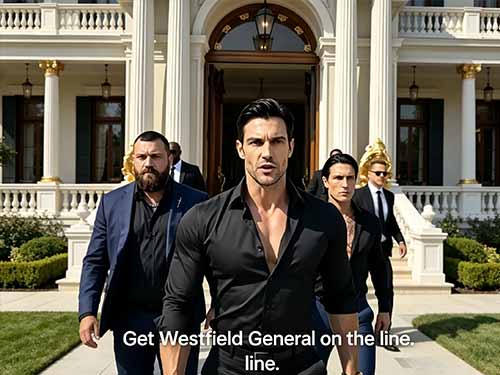
5. Humiliation Needs an Audience, and So Does the Reckoning
Last structural note, and it's the one that makes me think the ending will land.
Humiliation is not the same as pain. Pain you can suffer alone. Humiliation requires someone to see it — a witness, a crowd, a person who will remember you small.
So the synopsis telling us Hugo "endures humiliation" quietly establishes that this happened in public. There were people. There was a road, other drivers, maybe phones out.
And if the setup went to the trouble of making the degradation public, the payoff has to be public too. A private ruin wouldn't balance the books.
Which is exactly what "brought ruin upon their own family" delivers. Not a quiet misfortune behind closed doors — a name, a family, a standing in the world, taken apart where everyone can see it.
That symmetry is, as far as I'm concerned, the entire show — and judging by how much tit for tat drama gets shared, it's the part people keep talking about.
Open DramaBox to watch for free
Final Verdict: The Invoice, Not the Revenge
Most revenge stories bill themselves on the revenge. The fist, the scheme, the monologue over the bankruptcy paperwork.
This one bills on something quieter: the moment a shielded person discovers the shield was doing all the work.
The brats didn't attack Hugo because they wanted a fight. They attacked him because nothing had ever suggested that they couldn't. That's not malice — that's a worldview, and worldviews don't get corrected by arguments. They get corrected by evidence.
So tit for tat drama ends up meaning something slightly different than the phrase usually does. The "tat" isn't Hugo's. It never was. He didn't collect anything. He simply stayed in the car and let a family that had never been told no run into the one thing money can't wave away.
Click here to watch Tit for Tat on DramaBox
FAQ
How many episodes does Tit for Tat have, and where can I watch it?
Sixty-three, and if you want tit for tat drama as the full drama rather than a handful of clips, the complete run is on DramaBox, where you can watch online in the right order and watch free rather than piecing together uploads that usually cut before the fallout.
Does Hugo ever fight back?
I'm not going to map out the mechanics, because watching it unfold is the entire appeal. What I'll say is that the synopsis is unusually explicit about where the ruin lands, so this isn't a story that makes you wait to find out whether anything happens. The question isn't whether the Westons pay — it's how long it takes them to understand that they're paying.
What should I watch next if this worked for me?
If tit for tat drama hooked you with the underestimated-man-turns-out-to-be-load-bearing setup, Think Again! I'm the Hidden Boss Mom runs fifty-two episodes on almost exactly that engine, with the reveal played for longer. If it was the sheer satisfaction of a reckoning, Watch Out, I'm The Lady Boss runs sixty-four episodes and gets there faster. And if the family-as-liability angle was the draw, Queen Mom Rules runs sixty-three episodes with family and power tangled together from the first scene.
Can I watch it without paying?
Yes. DramaBox carries the full drama, so you can watch online and watch free there rather than paying for scattered pieces that tend to stall right before the reckoning.