




⚖️Tit for Tat Full : The Blind Spot They Built Themselves
Revenge DramaBox
 2026-09-15
 3
3Click here to watch the full version of Tit for Tat
Sophie is in labour. The car is on a road Hugo has driven a thousand times. And in that moment, the asphalt stops being asphalt and becomes a stage where one family performs power and another absorbs the cost. In my opinion, that is what makes tit for tat dramabox searches spike right now — a DramaBox show that understands the road itself was never neutral.
Here is my reading in six parts, from the highway as class theatre to why the Westons never saw him coming.
1. The Highway Was Never Neutral
Let's start where most people don't: the road itself.
Forcing a car off the highway is not an accident of location. It is a choice of venue. The Weston brats did not corner Hugo in a parking lot or ambush him at his door. They selected a public thoroughfare — a space designed for flow, for equal passage, for the temporary suspension of who owns what.
Open DramaBox to watch for free
And then they suspended the suspension.
What they did on that road was not personal. It was territorial. They treated a shared artery as private property because, for them, the distinction has long since dissolved. In my opinion, that is the first thing this show gets right that most urban revenge dramas miss: the violence begins not with a grudge, but with a worldview in which public space is already annexed.
The road is where they rehearse hierarchy. Every lane change, every tailgate, every forced brake is a reminder that their right of way is not legal — it is ontological. Hugo's car does not register as another vehicle with a woman in labour inside. It registers as an obstruction in a space that was supposed to belong to them.
That reframes the opening completely. We are not watching a random act of cruelty. We are watching a daily ritual that, for once, picked the wrong participant.
2. Hugo Was Never Hidden — He Was Invisible
Here is the angle I find most interesting, and I do not think the synopsis wants you to notice it immediately.
The Westons did not fail to identify Hugo. They failed to identify anyone in that position. Their system of perception does not include men in mid-range cars with pregnant wives. It includes rivals, servants, police, and other wealthy families. Everyone else is terrain.
So Hugo is not a hidden boss concealing his rank. He is a blind spot produced by the Weston cognitive architecture itself. They have spent generations refining a lens that filters out exactly his type of person — not threatening, not useful, not even entertaining. Just... absent from the model.
Open DramaBox to watch for free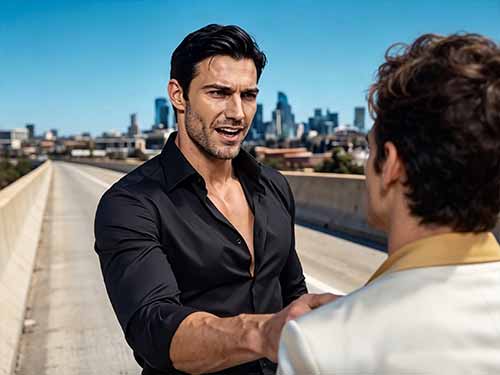
In my opinion, that is colder than any secret identity reveal. A concealed power says "I fooled you." A systemic blind spot says "You built a world where I could not be seen, and now that world is breaking because the thing it filtered out turned out to be load-bearing."
That is the engine behind tit for tat dramabox, and it is why the show does not need Hugo to deliver a speech about who he really is. The Weston system is already doing the work of its own collapse. He just has to stay in the car and let the feedback loop run.
3. Two Silences in One Car
I want to linger on the car for a moment, because I think the entire drama lives inside it.
There are two people in that vehicle. One is experiencing labour — a pain that is absolute, unshareable, and violently present. The other is experiencing humiliation — a pain that is equally absolute, equally unshareable, and invisible.
Sophie cannot explain what is happening in her body. Hugo cannot explain what is happening to his dignity. And neither can ask the other to prioritise their emergency, because both emergencies are happening in real time, in the same enclosed space, under the same ticking clock.
Open DramaBox to watch for free
As for me, that is the most emotionally honest setup in the whole show. Most revenge dramas would give Sophie one line — "Hugo, do something!" — to turn her into the audience surrogate, the voice of impatience that justifies the eventual explosion. This one leaves her silent. Not passive. Silent. Because a woman in labour is not waiting for her husband to prove himself. She is busy.
And Hugo's silence is not stoic heroism. It is triage. He is managing two crises with one set of hands, and the one that looks like inaction is actually the only action available. I'll admit it — I found that more moving than any punch he could have thrown.
4. Why Sixty-Three Episodes of Not Hitting Back
Let's be honest. Sixty-three episodes is a lot of runway for a premise that, on paper, sounds like it should resolve in ten.
But that length is not padding. It is the point.
The show is running on what I would call suspense aesthetics — the deliberate prolongation of a state the audience wants to end. Every episode that passes without Hugo striking back tightens the spring. Not because we doubt he will. Because we are being trained to feel the cost of waiting alongside him.
Open DramaBox to watch for free
That is a risky structure, and I'll admit it does not work for everyone. Some viewers want the counterattack by episode three. Fair. But for those who stay, tit for tat dramabox offers something rarer: the experience of patience as a shared ordeal. You do not watch Hugo endure humiliation. You endure it with him, episode by episode, until the distinction between his patience and yours starts to blur.
In my opinion, that is the show's real gamble. It bets that the audience can be converted from consumers of revenge into participants in restraint. And if it works — if you find yourself genuinely anxious for the release rather than impatient for it — then the eventual payoff lands with the weight of sixty-three episodes behind it, not just the weight of one incident.
5. The Weston Collapse as System Feedback
I want to return to the family ruin, because I think the wording matters more than it appears.
The synopsis says the brats "brought ruin upon their own family." Not upon themselves. Upon the family. And I do not think that is merely a description of collateral damage. It is a description of systemic failure.
The Weston family is not being punished by an external force. It is experiencing the consequences of its own design. A system that produces children who force labouring women off the road is a system that has disabled its own error-correction mechanisms. There is no adult in the room who can say "stop." There is no friend who can say "this is too far." There is only the architecture of entitlement, running unchecked, until it encounters the one input it cannot process: consequence.
Open DramaBox to watch for free
So the ruin is not karma. It is feedback. The system finally receives a signal it cannot ignore, and because the system has spent generations insulating itself from all lesser signals, the feedback arrives at fatal amplitude.
That is, as far as I'm concerned, the sharpest political reading tit for tat dramabox permits. Not a story about a good man defeating bad people. A story about a closed system destroying itself because it lost the capacity to recognise the boundary between performance and consequence.
6. Who This Is For — And Where to Watch It
If you are looking for a hero who monologues while buildings explode, this is not your show. If you are looking for a villain who twirls a moustache and explains the plan, look elsewhere.
Tit for tat dramabox is for viewers who can tolerate ambiguity. Who do not need every episode to end on a cliffhanger of violence. Who are willing to sit with a man in a car and trust that the architecture of the story will hold.
The full movie run is sixty-three episodes. You can watch online on DramaBox, where the complete full movie experience is available to watch free in the correct order. I would strongly recommend sequential viewing — the suspense aesthetics only function if you feel the accumulation, and skipping around turns Hugo's patience from a narrative strategy into a plot hole.
Open DramaBox to watch for free
Final Verdict: The Architecture Holds
I'll be direct. This is a slow burn. The brats are not complex, the dialogue is not poetry, and the premise wears its structure on its sleeve.
But the architecture holds. The road as class theatre, the blind spot as systemic failure, the two silences in one car — these are not accidental. They are load-bearing, and they carry the weight of sixty-three episodes without collapsing into tedium.
In my opinion, that is worth something. If you want to see whether the structure pays off, you can watch free on DramaBox tonight. Bring patience. The show will reward it.
FAQ
How many episodes does Tit for Tat have, and where can I watch the full drama?
There are 63 episodes total. You can watch online and enjoy the full movie experience on DramaBox, where all episodes are available in HD and in the correct order. The tit for tat dramabox experience is best consumed sequentially — the slow-burn structure depends on accumulation.
Does Hugo ever actually fight back?
I'm not going to spoil the mechanics. What I'll say is that the show is built on a structural bet: that restraint can be more compelling than release. Whether that bet pays off for you is, honestly, the entire question the show is asking.
What should I watch next if this worked for me?
If what hooked you was the underestimated-man-with-hidden-depth setup, For Richer, For Poorer runs sixty-five episodes on a similar engine of concealed identity and slow reckoning. If it was the urban revenge structure with family stakes, The Vanished Champ Strikes Back runs fifty-six episodes and gets to the counterattack faster. And if the family-collapse-as-system-feedback angle was the draw, Through Ashes Their Sorrow Awakens runs fifty-six episodes with concealed identity and generational ruin woven together from the start.
Can I watch it without paying?
Yes. DramaBox carries the complete run, so you can watch free and watch online there rather than paying for scattered pieces.