




Kindness with a Twist Korean Drama New Release Free: When Kindness Becomes a Weapon
Kindness with a Twist Korean Drama New Release Free: When Kindness Becomes a Weapon
Enemies to Lovers DramaBox
 2025-12-31
 279
279💔Introduction: Some Love Stories Are Meant to Break You
There is a particular kind of romance that does not comfort you. It unsettles you, irritates you, and lingers long after the screen goes dark. Kindness with a Twist Korean Drama belongs firmly in that category. It is not designed to make viewers feel safe. Instead, it asks an uncomfortable question: what happens when affection itself is weaponized?
Short dramas often rely on fast emotional payoff, but this one takes a risk by slowing down the cruelty. Every smile carries intent. Every tender word hides calculation. For viewers accustomed to clean redemption arcs and clearly defined villains, this series deliberately blurs moral boundaries. It understands that the most painful betrayals rarely come from enemies. They come from someone who once said, “Trust me.”
What makes this drama stand out on DramaBox is not simply its dark premise, but how confidently it leans into emotional contradiction. The story dares viewers to feel warmth and disgust at the same time, creating a viewing experience that feels both addictive and exhausting. That tension is precisely why it has become so divisive and so talked about.
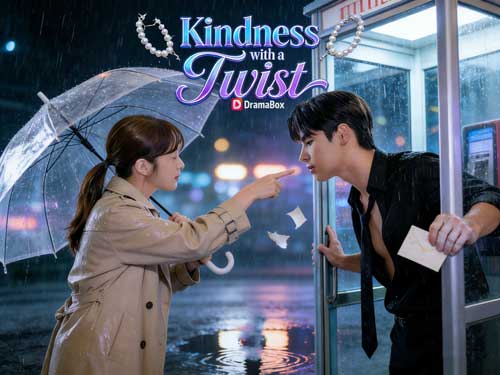
Open DramaBox to watch for free
🕊️Plot Overview: A Romance Built on Intention, Not Accident
At the center of Kindness with a Twist Korean Drama is Kang Junhwi, heir to a powerful conglomerate shattered by his mother’s death. Her suicide is not treated as a mystery to be solved, but as a wound that never closes. From that moment forward, Junhwi’s life becomes a single straight line pointing toward revenge.
Years later, his plan finally moves. His target is not the woman who betrayed his family, but her daughter, Baek Jinju. Jinju enters the story unaware that she is not being noticed by coincidence. Junhwi does not fall in love impulsively. He studies her, approaches her carefully, and mirrors her emotional needs with calculated precision. His kindness is deliberate. His patience is strategic.
The brilliance of the storytelling lies in how ordinary their relationship initially appears. Dates feel gentle. Confessions feel sincere. The drama allows viewers to forget, briefly, that everything is constructed. This illusion makes the eventual cruelty more devastating.
As Junhwi plans marriage as the final stage of his revenge, the series refuses to rush toward the reveal. Instead, it sits with the discomfort of watching a man grow closer to someone he fully intends to destroy. The longer the lie lasts, the harder it becomes to tell whether Junhwi is acting or unraveling.
This is not a traditional enemies to lovers setup. It is a story about emotional asymmetry, where one person enters a relationship with a future already written and the other believes she is simply falling in love.
🥀What Makes It Work: The Elegance of Emotional Violence
One of the most striking strengths of Kindness with a Twist Korean Drama is how restrained it is. There are no exaggerated villains or cartoonish cruelty. Junhwi’s revenge is chilling precisely because it is polite. His softness becomes the sharpest blade in the narrative.
The camera work supports this emotional precision. Close-up shots linger on expressions just long enough for discomfort to settle in. Warm lighting during romantic scenes creates a sense of safety that viewers instinctively trust, only to later realize they were complicit in the deception. This visual softness contrasts sharply with the moral ugliness beneath it.
Baek Jinju, meanwhile, is written with notable restraint. She is not naïve, but she is sincere. Her vulnerability comes from belief, not ignorance. That distinction matters. It ensures that when the betrayal unfolds, the tragedy feels earned rather than manipulative.
The series also resists the temptation to justify its male lead too quickly. Audience reactions reflect this choice clearly. Some viewers express satisfaction at seeing revenge enacted, while others remain deeply uncomfortable with Junhwi’s refusal to take responsibility for the harm he causes. That division is intentional. The drama does not demand forgiveness, nor does it offer easy absolution.
By weaving themes of revenge and toxic love into a romantic framework, the show challenges the fantasy that affection automatically redeems intent. In this story, love does not cleanse wrongdoing. It amplifies it.
🫀When Romance Is a Performance and Kindness Is a Script
What makes Kindness with a Twist particularly unsettling for Western audiences is how closely it mirrors a fear that feels uncomfortably familiar: the idea that intimacy can be staged. In many romantic dramas, deception appears as a short-lived misunderstanding, something cleared up in a heartfelt conversation. This story refuses that comfort. Here, affection is not spontaneous. It is rehearsed.
Junhwi’s romance with Jinju unfolds like a carefully directed play. He remembers details not because he cherishes them, but because information is leverage. His patience is flawless, his gentleness calibrated to inspire trust. To an American viewer used to romance as self-expression, this level of emotional control reads as quietly horrifying. It is not explosive villainy. It is the cold confidence of someone who believes he is morally justified.
What elevates the series is how convincingly it sells the illusion. Jinju’s reactions feel authentic, grounded, and emotionally legible. She does not fall in love because she is weak or foolish, but because the version of Junhwi she sees is precisely the man society tells her to trust. Kind, attentive, emotionally available. The drama asks viewers to confront an unsettling truth: if manipulation is gentle enough, most people will never recognize it until it is too late.
This dynamic resonates strongly with English-speaking audiences accustomed to stories about emotional labor, power imbalance, and the hidden costs of “nice” behavior. Junhwi’s kindness is not loud. It does not demand gratitude. It simply accumulates debt, scene by scene, until Jinju is emotionally invested beyond return.
The series becomes less about romance and more about consent. Can love be real if one person entered the relationship with an exit strategy already prepared? By refusing to answer that question quickly, the drama forces viewers to sit with the discomfort. That patience is rare in short-form storytelling, and it is exactly why the emotional impact hits harder.

Open DramaBox to watch for free
😈Revenge Without Victory: The Slow Collapse of Moral Certainty
Unlike many revenge-driven narratives popular in Western media, Kindness with a Twist does not reward its protagonist with catharsis. There is no moment where the audience can clap and say justice has been served. Instead, the closer Junhwi gets to executing his plan, the more hollow his victory becomes.
What American viewers may find especially compelling is how the drama treats revenge as an ongoing psychological cost rather than a final payoff. Junhwi does not become more powerful as the story progresses. He becomes more isolated. His internal monologue grows quieter, not because he has found peace, but because he has narrowed his emotional range to survive his own choices.
The tension peaks not in confrontation, but in silence. Scenes where Jinju expresses genuine happiness are far more devastating than any argument could be. The audience knows what she does not. Each moment of warmth becomes unbearable because it is temporary by design.
This approach aligns with a growing trend in English-language storytelling that interrogates the fantasy of revenge. Much like prestige dramas that explore morally compromised protagonists, this series understands that prolonged deception corrodes identity. Junhwi cannot remain the same man who started this plan. He is reshaped by it, and not in ways that feel empowering.
Importantly, the show does not romanticize his suffering. There is no implication that pain equals redemption. Even when remorse surfaces, it feels too late, not because forgiveness is impossible, but because damage has already been done in slow, irreversible increments.
For viewers accustomed to neat moral arcs, this refusal to absolve the protagonist can feel frustrating. But that frustration is intentional. It mirrors Jinju’s eventual emotional reckoning, when she realizes that love, once poisoned, cannot simply be filtered back into purity.
❓Why This Story Lingers Longer Than Comfort Allows
What ultimately makes Kindness with a Twist linger is not its plot twists, but its emotional aftertaste. Long after the final scenes, viewers are left questioning their own instincts. How often do we mistake consistency for sincerity? How often do we reward kindness without questioning intent?
For American audiences especially, the drama taps into a cultural anxiety around emotional authenticity. In a world that values charm, empathy, and emotional intelligence, this story dares to ask whether those traits can be weaponized. The answer it offers is unsettlingly clear.
Jinju’s pain does not explode outward. It collapses inward. Her silence carries more weight than confrontation ever could. The series treats her heartbreak with restraint, refusing melodrama in favor of quiet devastation. That choice makes her suffering feel real rather than performative.
The drama’s ending does not provide closure in the traditional sense. Instead, it offers consequence. Love does not undo harm. Apologies do not reset time. This emotional realism may divide viewers, but it also elevates the narrative beyond genre expectations.
In the crowded landscape of romance-driven short dramas, Kindness with a Twist stands apart by refusing to comfort its audience. It challenges the assumption that affection is inherently good, and instead frames it as something morally neutral, shaped entirely by intent.
That challenge is what makes the series unforgettable. It does not ask whether love is powerful. It asks whether power can ever truly love.
🤔Personal Take: Uncomfortable, Addictive, and Emotionally Expensive
Watching Kindness with a Twist Korean Drama feels like being invited into a beautifully decorated room only to realize the door has locked behind you. The experience is tense and often frustrating, but it is also undeniably compelling.
This is not a drama for viewers seeking comfort or pure sweetness. Even moments of tenderness feel heavy with implication. The male lead’s apology, when it comes, feels insufficient not because it lacks sincerity, but because no apology could ever balance the scale. That realism may anger some viewers, but it also gives the story weight.
What the series does exceptionally well is reflect a truth rarely acknowledged in romance narratives: time does not equal atonement. Ten months of affection cannot repay years of manipulation. The drama allows that imbalance to exist without forcing closure, which may be why reactions are so intense.
For audiences interested in darker romance, psychological tension, and morally complex storytelling, this is an excellent choice. It may not leave you satisfied, but it will leave you thinking.
🪞Conclusion: A Love Story That Refuses to Be Gentle
In the crowded world of short-form romantic dramas, Kindness with a Twist Korean Drama distinguishes itself by refusing to simplify pain. It is a story where kindness is not a virtue, but a tactic, and where love becomes the most dangerous form of control.
Available on DramaBox with English Version and English Subtitles, the series has gained attention among viewers seeking something sharper than conventional romance. Whether streamed as a Full Episode experience or discovered through short clips on YTb, its impact lingers far beyond its runtime.
This is not a drama that asks for approval. It asks for confrontation. And in doing so, it proves that even within the short drama format, there is room for stories that cut deep instead of comforting.
If you are ready for a romance that questions itself and its audience, this one is waiting.