




Step on Lies, Break Them All Chinese Drama Watch Online: Rising from the Ruins
Strong Female Lead DramaBox
 2026-01-26
 291
291From Love to Betrayal: Trisha’s Journey of Empowerment
Few stories capture the intensity of love, loss, and revenge with the precision and emotional depth of Step on Lies, Break Them All. Trisha Stewart’s decade-long marriage to Fred Quinn was not just personal; it was professional. Together, they built a modest food stall into a thriving corporation, a journey of shared dreams and hard-earned trust. Yet beneath the facade of success lay secrets, deception, and ambition that would soon shatter Trisha’s world.
The revelation is devastating. Fred’s betrayal is not merely emotional infidelity. He orchestrated a car accident that caused the loss of Trisha’s unborn child, ending her chance of motherhood, while simultaneously carrying on a hidden affair with her adoptive sister. The dual shock of betrayal and personal tragedy ignites a transformation. Trisha evolves from a loving wife and business partner into a calculated force of reckoning. Her journey embodies the strong female lead archetype, showcasing resilience, intelligence, and the strategic use of her emotional intelligence to reclaim what was stolen.
This narrative resonates with viewers who crave more than romance; they want stories of counterattack, of women navigating treacherous waters and emerging triumphant. Unlike traditional modern romance tales where heartbreak is melodramatic but shallow, this drama situates its heroine in a realistic, high-stakes world where power, wealth, and morality collide. Billionaire ambitions, corporate machinations, and personal vendettas intertwine, crafting a universe that is both glamorous and morally complex.
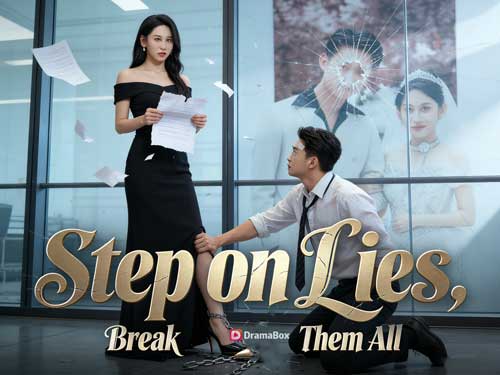
Open DramaBox to watch for free
Every Lie Counts: A Drama of Strategy, Emotion, and Justice
The storytelling in Step on Lies, Break Them All Chinese Drama is meticulous. Every episode peels back layers of deceit, revealing motives, regrets, and hidden alliances. Trisha’s approach is not reactive but strategic. She assesses who can be leveraged, who must be confronted, and how to dismantle the intricate web of treachery surrounding her. In a way, the series aligns with popular revenge sagas yet distinguishes itself by centering on personal agency and moral clarity rather than sheer spectacle.
Fred Quinn, the male lead, is crafted as more than a villain. He is charismatic, intelligent, and dangerously flawed, a classic love after divorce case study. His duality creates narrative tension: viewers understand his appeal even as they loathe his actions. The adoptive sister, meanwhile, embodies envy, ambition, and emotional immaturity, a perfect foil for Trisha’s emergent power. Their dynamic, combined with occasional appearances from the male second lead, injects depth into what could have been a one-dimensional revenge plot.
The series excels in visual storytelling. Director Miao Jian employs tight framing and subtle lighting shifts to convey power dynamics and emotional subtext. Trisha’s expressions in boardrooms or intimate conversations are as revealing as dialogue, allowing the audience to experience suspense and satisfaction in tandem. The narrative pacing encourages binge-watching, making it suitable for Full Episode consumption on platforms like DramaBox, with English Version options and English Subtitles ensuring accessibility to a global audience.
For comparison, while some revenge dramas focus purely on shock and scandal, this series balances modern romance and urban corporate intrigue. Trisha is relatable not because her situation is common, but because her reaction—grief, calculated revenge, and eventual empowerment—feels emotionally authentic.
The Fall of a Billionaire: Trisha’s Masterstroke
In the world of Step on Lies, Break Them All, wealth and power are both a weapon and a vulnerability. Trisha Stewart, once a devoted wife and co-founder of a thriving business empire, finds herself betrayed on every front. Her husband, Fred Quinn, not only orchestrates a car accident that destroys her unborn child but also maintains a secret affair with her adoptive sister. For many viewers, particularly in English-speaking regions, the emotional impact of this dual betrayal resonates strongly because it combines personal loss with corporate treachery, creating a revenge story that feels both modern and relatable.
Trisha’s response is calculated, precise, and psychologically compelling. Instead of succumbing to despair, she channels her pain into strategy, dismantling Fred’s business empire from within. This arc plays into the American audience’s love for strong female leads who reclaim power in ways that are both creative and satisfying. For instance, one of the most talked-about sequences involves Trisha leveraging insider knowledge about Fred’s financial mismanagement, forcing board members to side with her, all while keeping Fred oblivious until the very moment his empire collapses. The tension here is cinematic, reminiscent of shows like Revenge or Dynasty, where the thrill comes from watching the underdog execute a perfect counterattack against the seemingly untouchable billionaire.
The drama balances this high-stakes corporate maneuvering with emotional beats that make the narrative grounded. Trisha doesn’t just want revenge for professional sabotage; she wants personal closure. Scenes depicting her confronting Fred and her sister are raw, intense, and dialogue-driven. Lines like “You didn’t just betray me; you erased my future” strike with the kind of emotional clarity that appeals to audiences seeking depth beyond action. The writers cleverly juxtapose boardroom strategy with intimate personal confrontations, creating a narrative rhythm that maintains suspense while delivering satisfying payoffs.
Moreover, the cinematography emphasizes this duality. Sweeping shots of the corporate skyscraper where Trisha and Fred built their empire contrast sharply with the claustrophobic interiors of Fred’s private office, where Trisha executes the psychological dismantling. The visual storytelling resonates with viewers accustomed to high-production-value American dramas, reinforcing the stakes and heightening the emotional impact. By positioning Trisha as both tactician and emotional anchor, Step on Lies, Break Them All Chinese Drama achieves a delicate balance between spectacle and character-driven storytelling, making her triumph not just believable but cathartically enjoyable.
Why Viewers Keep Coming Back: Character Depth and Emotional Resonance
What makes Step on Lies, Break Them All Chinese Drama stand out is the investment in its characters. Trisha’s evolution is central: she transforms from victim to strategist without losing her humanity. The drama avoids portraying her solely as a vengeance machine; instead, it emphasizes moral nuance and emotional intelligence. Audiences can cheer for her while still grappling with ethical dilemmas posed by her actions.
Supporting characters further enhance the complexity. The adoptive sister’s imprisonment serves as a narrative milestone where justice is served, yet the consequences are emotionally layered rather than purely punitive. Fred Quinn’s descent into ruin is depicted with nuance, highlighting the destructive nature of greed and betrayal, while also providing a cautionary tale about toxic love and misplaced trust.
The narrative’s interplay of pregnancy, loss, corporate power, and romantic entanglements makes it resonate with viewers of all demographics. Social media buzz around the series emphasizes Trisha’s status as an independent woman navigating treacherous waters, while casual clips on YTb and DramaBox teasers highlight pivotal moments of triumph and emotional confrontation. Its Exclusive copyright and First release on the entire network have bolstered its visibility, positioning it as a must-watch in the Free Movie short drama category.
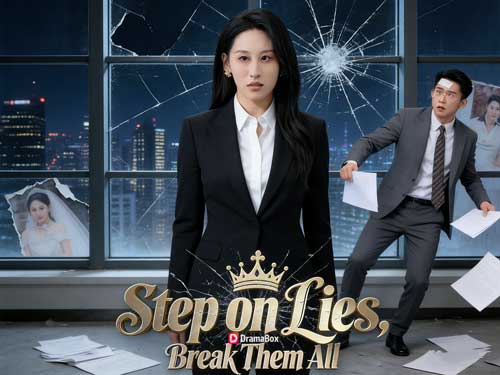
Open DramaBox to watch for free
Blood Ties and Betrayal: Family as the Ultimate Weapon
The tension between family loyalty and personal ambition is at the core of Step on Lies, Break Them All. Trisha’s adoptive sister, a character whose charm hides deep-seated jealousy, represents a compelling antagonist that American audiences often find fascinating in revenge narratives. The drama amplifies the psychological stakes by weaving family betrayal into the narrative, giving viewers an additional layer of intrigue beyond the romantic and corporate conflicts.
One standout arc that captures audience attention involves a public charity gala hosted by Fred’s company. Trisha manipulates the event to expose the affair between Fred and her sister without compromising her own dignity. The scene is masterfully orchestrated: subtle exchanges of glances, strategically placed documents, and carefully timed disclosures lead to a public confrontation that humiliates her adversaries while simultaneously asserting Trisha’s moral and intellectual superiority. For viewers familiar with shows like Scandal or Big Little Lies, these sequences evoke the same thrill of watching clever strategy unfold in a high-pressure social setting.
The psychological interplay extends beyond spectacle. Trisha’s sister is not a one-note villain; she oscillates between regret and ambition, forcing Trisha to navigate the fine line between personal revenge and ethical conduct. These morally complex interactions give the drama depth, ensuring that audiences are emotionally invested in every twist. The sister’s eventual arrest, while satisfying, is not the endpoint; the drama allows the audience to dwell on the consequences of betrayal, a narrative choice that deepens engagement and fosters discussion about loyalty, trust, and accountability.
Personal Take: Elegant Revenge Wrapped in Emotional Truth
From a critical perspective, Step on Lies, Break Them All Chinese Drama succeeds because it combines emotional authenticity with strategic storytelling. The tension between love, betrayal, and ambition is carefully calibrated, never tipping into melodrama for cheap thrills. Its writing respects the audience’s intelligence, trusting viewers to follow complex character arcs and intricate plot maneuvers.
Some moments might feel intense, particularly regarding Trisha’s moral choices, yet that intensity is purposeful. It reinforces the stakes and makes her eventual victories immensely satisfying. This is a drama where heartbreak catalyzes growth, where secret crushes, emotional manipulation, and business rivalry intersect to produce a narrative that is both cathartic and entertaining.
For viewers who appreciate narratives about strong female leads, intricate betrayals, and corporate revenge with a personal edge, this drama is a rare find. Its pacing, cinematography, and character depth make it ideal for both binge-watching and thoughtful analysis.
Final Thoughts: Rebuilding from Ruins, Claiming a Throne
Ultimately, Step on Lies, Break Them All Chinese Drama is a story of reclamation. Trisha Stewart rises from the devastation of personal and professional betrayal to reclaim her life, her dignity, and her empire. It is a drama that celebrates agency, intelligence, and moral resilience, reminding audiences that the path to justice is rarely simple, but always rewarding when navigated with clarity and courage.
For those drawn to corporate intrigue, revenge sagas, and emotionally intelligent modern romance, this drama promises both excitement and insight. Step on Lies, Break Them All Chinese Drama is a must-watch for anyone who believes that empowerment and love can coexist, even in the shadow of betrayal.
Cast and Production Spotlight
Ding Lei as Trisha Stewart (丁磊)
Born 2001 in Harbin, Heilongjiang, Ding Lei is a Chinese actress known for Absolute Vision, Reignited, and Racing Life 1988. She embodies Trisha’s resilience and calculated emotional intelligence with elegance.
Li Shixin, Stage Name Li Jingchuan as Fred Quinn (李世鑫/李景川)
Standing 185 cm, Li Jingchuan is a graduate of Harbin Normal University. His works include Righteousness Restarts, Life in the Sixties: Sister Rural Journey. He portrays Fred with charm, menace, and vulnerability.
Ma Xinlei as the Adoptive Sister (马欣蕾)
Born 2000 in Tangshan, Hebei, Ma Xinlei studies at Shanxi Media University and excels in jazz and folk dance. Her previous works include When the Sea Blew Over My Grave. She portrays the morally conflicted sister with nuance.
Wang Shenglin as the Male Second Lead (王圣琳)
Born May 20, 2003, Wang Shenglin’s credits include After Flash Marriage, President Sang Exposed and The Fortune Teller Heiress. He adds tension and depth to the romantic subplot.
Director Miao Jian (苗键)
Renowned for I Am Not a Food God and other productions, Miao Jian combines visual storytelling, pacing, and emotional nuance, ensuring the series delivers suspense, drama, and cathartic satisfaction.